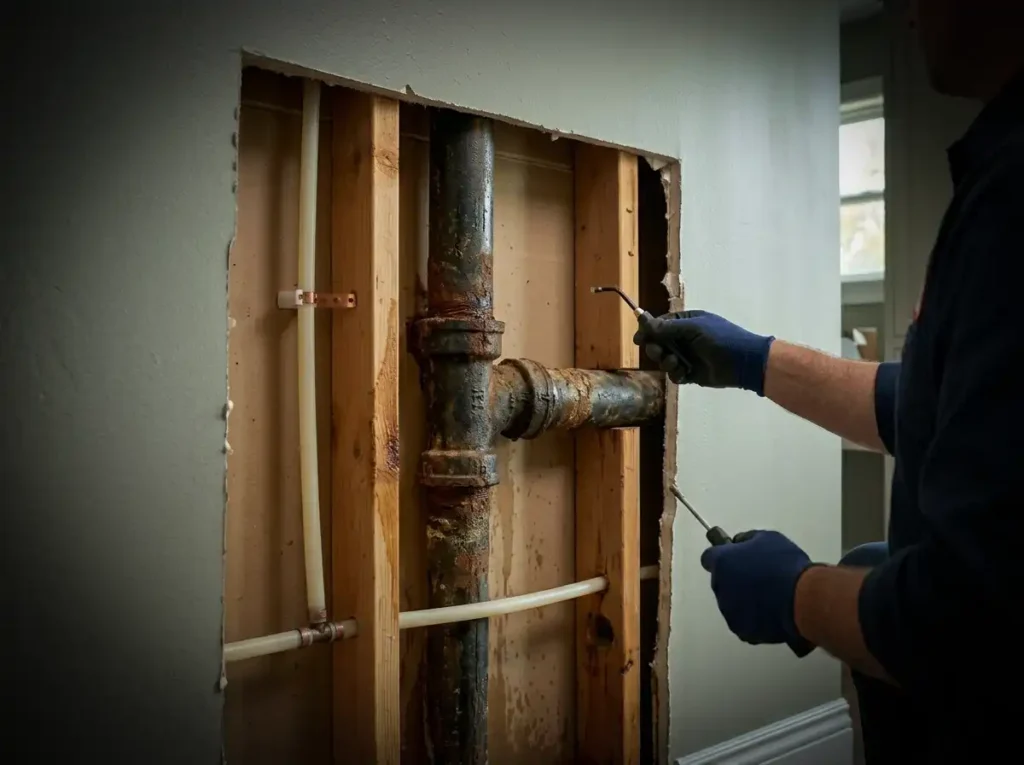
Thousands of homes across East San Diego County were built with cast iron drain and sewer lines between the 1950s and 1970s. At the time, cast iron was the standard material for residential plumbing — durable, fire-resistant, and expected to last 50 to 75 years. That engineering estimate has held up reasonably well. The problem is simple arithmetic: pipes installed in 1965 are now over 60 years old. Many have reached or exceeded their designed lifespan, and the signs of deterioration are showing up in homes throughout El Cajon, La Mesa, San Carlos, and surrounding neighborhoods.
Understanding what’s happening with your cast iron pipes — and knowing your options — puts you in a much better position than waiting for an emergency.
Which East County Neighborhoods Have Cast Iron Pipes?
If your home was built between roughly 1950 and 1975, there’s a strong chance your drain and sewer lines are cast iron. The neighborhoods most likely to have cast iron plumbing include:
- El Cajon — Downtown, the Main Street corridor, and the older residential neighborhoods north and south of Interstate 8
- La Mesa — The Village, the Spring Street area, and homes near University Avenue
- Lemon Grove — The Broadway corridor and Massachusetts Avenue neighborhoods
- San Carlos — Navajo Road, Lake Murray Boulevard, and the Golfcrest area
- East San Diego — City Heights, Oak Park, and Chollas View
- Spring Valley and parts of Santee — particularly the older developments near town centers
If your home was built after 1975, your drain lines are most likely ABS or PVC plastic, which have a significantly longer expected lifespan (50-100+ years) and don’t suffer from the same corrosion issues as cast iron.
Not sure what your home has? The build date is a strong indicator, but a sewer camera inspection gives you a definitive answer in about 30 minutes.
Signs Your Cast Iron Pipes Are Failing
Cast iron deterioration happens from the inside out, so you can’t see the damage by looking at exposed pipes in your basement or crawl space. The exterior may look solid while the interior is heavily corroded. Here’s what failing cast iron pipes typically produce at the fixture level:
- Multiple slow drains — When several fixtures drain slowly at the same time, the mainline is restricted
- Sewage odors — Cracks and corrosion holes allow sewer gas to escape into your home or yard
- Gurgling sounds — Air entering through cracks in the pipe creates gurgling at fixtures when other drains are used
- Recurring backups — Multiple sewer backups per year indicate significant internal deterioration
- Sinkholes or soft spots in the yard — Leaking sewage erodes soil around the pipe, creating depressions at the surface
- Foundation cracks near drain lines — Leaking pipes beneath a slab foundation can undermine the soil supporting the foundation
- Water stains on slab floors — Under-slab sewer leaks can wick moisture up through concrete
Any one of these signs warrants an inspection. Multiple signs occurring together strongly suggest your cast iron is reaching the end of its functional life.
How We Inspect Cast Iron Pipes
We insert a high-definition sewer camera through a cleanout access point and push it through the entire drain and sewer line, from your house to the street connection. The camera provides a real-time video feed that shows the exact condition of the pipe interior — and you watch the footage with us so you see exactly what we see.
The camera inspection reveals:
- Scaling and corrosion — How much of the pipe wall has been eaten away by rust and mineral deposits
- Bellies — Low spots where the pipe has sagged, creating standing water that accelerates corrosion
- Root intrusion — Tree roots entering through cracked joints or corrosion holes
- Cracks and fractures — Structural failures that will worsen over time
- Collapses — Sections where the pipe has failed entirely and the soil has filled in
After the inspection, we provide a written assessment that documents the pipe condition section by section, along with our recommendations. This gives you the information you need to make a decision — whether that’s monitoring, targeted repair, or full replacement.
Repair Options for Failing Cast Iron
Not every failing cast iron pipe needs complete replacement. The right approach depends on the extent and location of the damage:
Spot repair: If damage is limited to one section — a single crack, a localized area of corrosion, or a root intrusion point — we can cut out and replace just that segment (typically 4 to 8 feet) with modern ABS pipe. This is the most cost-effective option when the rest of the line is still in serviceable condition. It’s a targeted fix that addresses the immediate problem without the cost of a full replacement.
Trenchless pipe lining (CIPP): Cured-in-place pipe lining involves pulling a resin-coated flexible liner through the existing pipe, then inflating it against the pipe walls and curing it with heat or UV light. The result is essentially a new pipe inside the old one — smooth, joint-free, and resistant to roots and corrosion. The major advantage is that it requires minimal digging — usually just access at the cleanout and possibly one small excavation point. Trenchless lining works well when the pipe has consistent diameter throughout and no major collapses or offsets.
Full replacement: When the line is extensively corroded, collapsed in multiple locations, or has significant bellies that can’t be lined effectively, full replacement with modern ABS or PVC pipe is the most reliable long-term solution. This involves trenching along the sewer line route, removing the old cast iron, and installing new pipe. It’s the most disruptive option but provides a completely new system with a 50+ year expected lifespan.
What Does Cast Iron Replacement Cost?
Costs vary based on the length of the line, depth of burial, access conditions, landscaping impact, and the repair method chosen:
- Spot repair: $1,500 to $4,000 — depends on depth and location of the damaged section
- Trenchless lining (CIPP): $4,000 to $8,000 — depends on total line length and access
- Full replacement: $5,000 to $15,000 — depends on line length, depth, and whether the line runs under concrete, landscaping, or driveways
We provide free camera inspections with a written condition assessment, so you can see the actual state of your pipes and understand all available options before committing to any work. There’s no pressure and no obligation — the information is yours to use on your timeline.
Don’t Wait for a Collapse
The worst-case scenario with aging cast iron is a complete sewer line collapse. When a section of pipe fails entirely, the soil around it fills in and creates a total blockage. Sewage backs up into your home through the lowest fixtures — floor drains, toilets, showers. The resulting damage can include contaminated flooring, damaged drywall, ruined personal property, and the health hazards associated with raw sewage exposure.
Emergency sewer replacement costs significantly more than planned replacement. You’re paying premium rates for immediate service, and you don’t have time to compare options or get multiple quotes. The disruption to your daily life is also more severe — you can’t use any plumbing in your home until the line is repaired.
Regular camera inspections — every 2 to 3 years for cast iron sewer lines — catch deterioration early and give you time to plan and budget for repairs. A $200 inspection every few years is a small investment compared to a $15,000 emergency replacement.
Drain and sewer repair services
Hydro jetting for cast iron maintenance
Own an older East County home? Call RD Hydrojet at (619) 571-1777 for a free sewer camera inspection. We’ll show you the exact condition of your pipes and give you honest options — no pressure, no surprises.